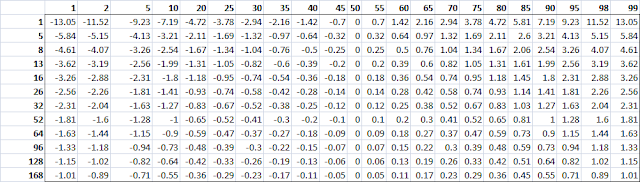
It is important to make a distinction between the IMPs per board average for a given
pair in a field and the IMPs per board standard deviation on the board set.
When we have a field of pairs, there will be pairs that are stronger than others. There is a range of strengths, and this strength can be quantified, e.g. in the form of an "expected IMPs per board score" for each pair. Each pair has only one given strength, compared to the rest of the field. The whole field is made up of several pairs and this whole field has a "strength distribution". One can model the strength of this field. One can assume, as I did, that the strength of the players is "normally distributed". A normal distribution can be described by two parameters: the average and the standard deviation of the distribution. It is important to realize that this standard deviation is
not an error. It is a parameter of the distribution, just like apples on a tree will have a weight distribution. If you weight two apples and you get a different result, it is likely that it is because of the difference in weight of the apples, not because of a random error in the scale.
Unfortunately, errors are also expressed as standard deviations. It is a bit like the difference between pound (mass) and pound (force): They have the same name, and there is a relation between the two, but they are fundamentally different things.
The errors only come into the discussion once we want to measure the strength of a pair, e.g. in a tournament. And we want to measure them, because we don't know the strength of the pairs. We know that each pair must have a strength, but we just don't know its value. So, we
estimate their strength, based on the results of the tournament. And when we estimate, we make errors.
In a bridge tournament, there are large random errors in the measurement. This is one of the charms in bridge: There is a realistic probability that Aunt Millie - Uncle Bob beat Meckwell on a single board. It would be premature to conclude that Aunt Millie - Uncle Bob are stronger that Meckwell based on that one board (though I would never deny Aunt Millie and Uncle Bob their moment of glory). The probability that Aunt Millie and Uncle Bob manage that on more boards gets less and less realistic.
So, if we play more and more boards, our tournament result will converge towards the true "strength distribution". The error in the estimate (whether due to the variation in the swinginess of boards or random differences caused by kings sitting over or under aces) will get closer to 0. In contrast, the standard deviation in the pair strength distribution will remain unchanged, because the true value of all the pairs' strength doesnot depend on the measurement.
So, what we are doing in a bridge tournament is the same as determining the weight distribution of the apples on a windy day with a scale that is jumping up and down in the wind: we have a large error in the measurement of the weight of the individual apples. But if we keep repeating the measurement over and over again, we will get a better estimated value for the weight of each apple. And we can use these to determine the weight distribution of the apples in the tree.
In this thread, the question was more or less: the mass of my apple (my bridge strength) from my tree (played in BBO) is x% (x IMPs/bd) larger than the average. What does that mean? I took another tree (bridge club), measured the weight distribution of its apples (measured the strength distribution of the players) and said: "If your tree (BBO) is comparable to mine (my bridge club), it would mean that so many % of the apples (pairs) are lighter (worse) than yours (you)."
All this shows that it is perfectly possible to compare apples and pairs...

Rik
I want my opponents to leave my table with a smile on their face and without matchpoints on their score card - in that order.
The most exciting phrase to hear in science, the one that heralds the new discoveries, is not “Eureka!” (I found it!), but “That’s funny…” – Isaac Asimov
The only reason God did not put "Thou shalt mind thine own business" in the Ten Commandments was that He thought that it was too obvious to need stating. - Kenberg

 Help
Help


 helene_t, on 2013-November-07, 06:59, said: