
BBO Discussion Forums: The Barack W. Backlash Begins - BBO Discussion Forums

Jump to content

  • 7 Pages +
  • « First
  • 2
  • 3
  • 4
  • 5
  • 6
  • Last »
  • You cannot start a new topic
  • You cannot reply to this topic

The Barack W. Backlash Begins The times they are a changin'

#61 User is offline   jdonn 

  • - - T98765432 AQT8
  • PipPipPipPipPipPipPipPipPipPipPip
  • Group: Advanced Members
  • Posts: 15,085
  • Joined: 2005-June-23
  • Gender:Male
  • Location:Las Vegas, NV

Posted 2010-January-23, 13:20

luke warm, on Jan 23 2010, 10:55 AM, said:

mike777, on Jan 23 2010, 10:29 AM, said:

It would be interesting for a Brown voter to post why they voted the way they did.


I get the impression most water coolers would not have voted for him, if given the chance.


As for the Barack backlash, I don't see that he has lost even one water cooler voter. There may be a bit of unhappiness but we all expected that over time but I dont see that he has lost a voter.

good point... i think people are giving their opinions as to why *others* feel a little disenfranchised, or why the republican party might not have gasped its last (which was pretty much the consensus here a few months ago)

This is truly a misrepresentation of what I'm almost sure you're referring to...
Please let me know about any questions or interest or bug reports about GIB.
0

#62 User is offline   Winstonm 

  • PipPipPipPipPipPipPipPipPipPipPip
  • Group: Advanced Members
  • Posts: 17,289
  • Joined: 2005-January-08
  • Gender:Male
  • Location:Tulsa, Oklahoma
  • Interests:Art, music

Posted 2010-January-23, 14:06

This has much to do with current political trends IMO:

Quote

A new study from the Brookings Institution tells us that the largest and fastest-growing population of poor people in the U.S. is in the suburbs.  From 2000 to 2008, the number of poor people in the U.S. grew by 5.2 million, reaching nearly 40 million. That represented an increase of 15.4 percent in the poor population, which was more than twice the increase in the population as a whole during that period.

The study does not include data from 2009, when so many millions of families were just hammered by the recession. So the reality is worse than the Brookings figures would indicate.

Job losses, stagnant or reduced wages over the past decade, and the loss of home equity when the housing bubble burst have combined to take a horrendous toll on families who thought they had done all the right things and were living the dream. A great deal of that bleeding is in the suburbs. The study, compiled by the Brookings Metropolitan Policy Program, said, “Suburbs gained more than 2.5 million poor individuals, accounting for almost half of the total increase in the nation’s poor population since 2000.”

"Injustice anywhere is a threat to justice everywhere."
0

#63 User is offline   mike777 

  • PipPipPipPipPipPipPipPipPipPipPip
  • Group: Advanced Members
  • Posts: 18,348
  • Joined: 2003-October-07
  • Gender:Male

Posted 2010-January-23, 15:00

Winstonm, on Jan 23 2010, 03:06 PM, said:

This has much to do with current political trends IMO:

Quote

A new study from the Brookings Institution tells us that the largest and fastest-growing population of poor people in the U.S. is in the suburbs.  From 2000 to 2008, the number of poor people in the U.S. grew by 5.2 million, reaching nearly 40 million. That represented an increase of 15.4 percent in the poor population, which was more than twice the increase in the population as a whole during that period.

The study does not include data from 2009, when so many millions of families were just hammered by the recession. So the reality is worse than the Brookings figures would indicate.

Job losses, stagnant or reduced wages over the past decade, and the loss of home equity when the housing bubble burst have combined to take a horrendous toll on families who thought they had done all the right things and were living the dream. A great deal of that bleeding is in the suburbs. The study, compiled by the Brookings Metropolitan Policy Program, said, “Suburbs gained more than 2.5 million poor individuals, accounting for almost half of the total increase in the nation’s poor population since 2000.”

I need to see a lot more information before I am willing to blame the housing bubble bursting as a cause and not as simply a result of something else happening such as people losing their jobs.

People in general do not walk away from their home just because they lost some home equity.


Also on the surface it seems weird that home prices soared for most of this period if massive amounts of people were losing their job, or having their wages reduced.

I mean just speaking for myself if I lose a job or take a big pay cut I am not going out buying a new home at even higher prices.
0

#64 User is offline   Winstonm 

  • PipPipPipPipPipPipPipPipPipPipPip
  • Group: Advanced Members
  • Posts: 17,289
  • Joined: 2005-January-08
  • Gender:Male
  • Location:Tulsa, Oklahoma
  • Interests:Art, music

Posted 2010-January-23, 15:13

Quote

People in general do not walk away from their home just because they lost some home equity.


Mike, with LTV >100% these didn't really qualify as homes, did they? These were really only bank rental units whose mortgages were packaged and sold as fast as they could be closed.

The only "wealth effect" created was in skimming commissions from the process.
"Injustice anywhere is a threat to justice everywhere."
0

#65 User is offline   mike777 

  • PipPipPipPipPipPipPipPipPipPipPip
  • Group: Advanced Members
  • Posts: 18,348
  • Joined: 2003-October-07
  • Gender:Male

Posted 2010-January-23, 15:17

Winstonm, on Jan 23 2010, 04:13 PM, said:

Quote

People in general do not walk away from their home just because they lost some home equity.


Mike, with LTV >100% these didn't really qualify as homes, did they? These were really only bank rental units whose mortgages were packaged and sold as fast as they could be closed.

The only "wealth effect" created was in skimming commissions from the process.

Your article said these people did all the right things.

So this is the fault of the greedy banks for letting you buy a house with no money down and creating jobs for my employees? I guess one solution is to make the banks loan less, alot less and only to people who are rich,really rich.

I mean I dont get the logic of your entire quote of this study.

Over the past decade millions more became poor, evenmore millions lost their jobs or their wages were cut or stagnant yet they claim there was a housing bubble.

1) I mean if house prices do not fall or stay the same when people lose jobs or take pay cuts
2) The supply of homes increased alot over this period.
3) yet despite all of the above people are out buying homes like crazy at ever higher prices
4) yet these people did all the right things
5) Ok , I guess these people were living a dream to quote your article.

BTW the recession did not start in 2009, in fact it may have started 2007.
OFf the top of my head i think the high on sp was what october 2007?

adjusted for inflation it might be the year 2000 but not sure.

So one might claim according the stock market we have been in a recession since 2000

If so then a growing number of poor, increased job losses and wage cuts and a loss in home equity prices makes sense.

Now if we just knew what caused the recession in 2000.
0

#66 User is offline   Winstonm 

  • PipPipPipPipPipPipPipPipPipPipPip
  • Group: Advanced Members
  • Posts: 17,289
  • Joined: 2005-January-08
  • Gender:Male
  • Location:Tulsa, Oklahoma
  • Interests:Art, music

Posted 2010-January-23, 16:06

Quote

Your article said these people did all the right things.
(No, the article said people who thought they had done the right thing.)

Quote

So this is the fault of the greedy banks for letting you buy a house with no money down and creating jobs for my employees?
(No, it said: Job losses, stagnant or reduced wages over the past decade)

Quote

I mean I dont get the logic of your entire quote of this study
. (That does not shock)

Quote

Over the past decade millions more became poor, evenmore millions lost their jobs or their wages were cut or stagnant yet they claim there was a housing bubble.

BTW the recession did not start in 2009, in fact it may have started 2007.
OFf the top of my head i think the high on sp was what october 2007?

(NBER dates the recession start as December 2007, when all the ecomonists were saying there would be no recession.)

It's not really all that hard to understand - productivity gains were not passed on as wage increases and therefore new debt had to replace the demand for the increased supply - until solvency pulled the plug on the party.

You can fake wealth for a long time on borrowed money and bubbles.
"Injustice anywhere is a threat to justice everywhere."
0

#67 User is offline   mike777 

  • PipPipPipPipPipPipPipPipPipPipPip
  • Group: Advanced Members
  • Posts: 18,348
  • Joined: 2003-October-07
  • Gender:Male

Posted 2010-January-23, 16:31

So the article seems to say nothing but the obvious..ok and then not well.
AGain you seem to argue without saying so that the credit crises caused the problem. Borrowed money made fake wealth...of course if the wealth is fake it seems it created nothing but ok..

Of course borrowed money can create real wealth also so not sure what your point is. I mean why does borrowed money create realwealth and why did it not here as you claim?

I argue you might be right but prove the credit crises caused the recession.

My guess is the recession caused the credit crises per Fama. NOt the other way around.

Again read the article you quoted, it really does not make sense with the information provided.

People do not walk away from their home just because equity prices fall.

Housing prices do not fall because of some break in some bubble. Housing prices fall because people lost jobs...they lost jobs worldwide. Now the real question is why did people lose jobs. Why the decrease in economic activity?

I mean look you do not walk away from your car or tv just because it goes down in value.

Something else is going on, my guess is recession.


If the article just said we have been in a recession since 2000 ok......that means jobs lost, equity prices down, wages stagnant, millions more poor people..ok but that is what one would expect.

btw I guess you can define recession anyway you wish. Keep in mind even these official guys NBER may have it wrong, very wrong.
0

#68 User is offline   Winstonm 

  • PipPipPipPipPipPipPipPipPipPipPip
  • Group: Advanced Members
  • Posts: 17,289
  • Joined: 2005-January-08
  • Gender:Male
  • Location:Tulsa, Oklahoma
  • Interests:Art, music

Posted 2010-January-23, 17:50

Quote

btw I guess you can define recession anyway you wish. Keep in mind even these official guys NBER may have it wrong, very wrong.


If words have no meaning, what is the point?
"Injustice anywhere is a threat to justice everywhere."
0

#69 User is offline   Winstonm 

  • PipPipPipPipPipPipPipPipPipPipPip
  • Group: Advanced Members
  • Posts: 17,289
  • Joined: 2005-January-08
  • Gender:Male
  • Location:Tulsa, Oklahoma
  • Interests:Art, music

Posted 2010-January-23, 18:04

Quote

I need to see a lot more information before I am willing to blame the housing bubble bursting as a cause and not as simply a result of something else happening such as people losing their jobs.


I suggest "Bailout Nation" by Barry Ritholtz.
"Injustice anywhere is a threat to justice everywhere."
0

#70 User is offline   mike777 

  • PipPipPipPipPipPipPipPipPipPipPip
  • Group: Advanced Members
  • Posts: 18,348
  • Joined: 2003-October-07
  • Gender:Male

Posted 2010-January-23, 23:05

Winstonm, on Jan 23 2010, 03:06 PM, said:

This has much to do with current political trends IMO:

Quote

A new study from the Brookings Institution tells us that the largest and fastest-growing population of poor people in the U.S. is in the suburbs.  From 2000 to 2008, the number of poor people in the U.S. grew by 5.2 million, reaching nearly 40 million. That represented an increase of 15.4 percent in the poor population, which was more than twice the increase in the population as a whole during that period.

The study does not include data from 2009, when so many millions of families were just hammered by the recession. So the reality is worse than the Brookings figures would indicate.

Job losses, stagnant or reduced wages over the past decade, and the loss of home equity when the housing bubble burst have combined to take a horrendous toll on families who thought they had done all the right things and were living the dream. A great deal of that bleeding is in the suburbs. The study, compiled by the Brookings Metropolitan Policy Program, said, “Suburbs gained more than 2.5 million poor individuals, accounting for almost half of the total increase in the nation’s poor population since 2000.”

FWIW


1) the last high on the sp 500 was october 2007......are we in a recession since then?
2) inflation adjusted the last high was 2000....are we in a recession since 2000?
3) some say a recession is caused by lack of spending( i dont know) but what causes the lack of spending oh well, interesting.

http://en.wikipedia.org/wiki/Recession


In any event I do not think people in general walk away from their home because they lost equity.


If you claim a housing bubble then I think you need to prove one,bubbles exist, two, a housing bubble existed.


to put this in simple terms...is a housing bubble just mean housing prices are above the mean...however you define "housing mean"?


I say this in the sense I do invest very often in "regression to the mean" and yes I think housing prices were far above the mean.

In this case I was a long long term investor in FNMA. 20 years. I thought FNMA printed money in some large sense of the meaning. But at some point the last few years I thought FNMA was corrupted, again in a large sense of the word so I got out of FNMA. I missed that market could corrupt the world. A few others did not.


But still I think the loss of worldwide jobs created the credit crises not the other way round.

What created the loss of jobs I missed.
----------


With all of that said...you may be right...very right.
0

#71 User is offline   Al_U_Card 

  • PipPipPipPipPipPipPipPip
  • Group: Advanced Members
  • Posts: 6,080
  • Joined: 2005-May-16
  • Gender:Male

Posted 2010-January-24, 07:01

The invisible hand is around our throats and it is tightening it's grip.

Finance makes the world go round but global finance makes the individual spin like a top. It has always been an issue of value for money. When that value is speculative (non-existent) then that value has to come from somewhere and that where is our pockets since we do not "create" CDOs etc. we just provide goods and services to which we assign a value in terms of time and sweat equity.

Whenever times are good, productivity and efficiency are high but that attracts the rapacious that then horn-in on the glory and start to figure out ways to siphon away as much as they can get away with.

Whenever times are bad, that invisible hand is ready, willing and able to scoop up all sorts of assets with it's ill-gotten gains. When these practices are condoned and encouraged, we all lose in the long run no matter how rosy a picture is painted in the short term.
The Grand Design, reflected in the face of Chaos...it's a fluke!
0

#72 User is offline   Winstonm 

  • PipPipPipPipPipPipPipPipPipPipPip
  • Group: Advanced Members
  • Posts: 17,289
  • Joined: 2005-January-08
  • Gender:Male
  • Location:Tulsa, Oklahoma
  • Interests:Art, music

Posted 2010-January-24, 11:08

Boston is laying off 200 police officers due to budget constraints.
"Injustice anywhere is a threat to justice everywhere."
0

#73 User is offline   Al_U_Card 

  • PipPipPipPipPipPipPipPip
  • Group: Advanced Members
  • Posts: 6,080
  • Joined: 2005-May-16
  • Gender:Male

Posted 2010-January-24, 12:24

Winstonm, on Jan 24 2010, 12:08 PM, said:

Boston is laying off 200 police officers due to budget constraints.

They can always use soldiers since that barrier has been eroded away....
The Grand Design, reflected in the face of Chaos...it's a fluke!
0

#74 User is offline   y66 

  • PipPipPipPipPipPipPipPip
  • Group: Advanced Members
  • Posts: 6,497
  • Joined: 2006-February-24

Posted 2010-January-24, 15:05

kenberg, on Jan 23 2010, 10:55 AM, said:

It would be good to know the extent of people's opposition to the health care bill(s) and it would be good to know whether the opposition is to this particular bill or whether they are opposed to doing anything at all about health care issues ever.

Posted on 1/21 on 538:

Quote

... polls have consistently shown that support for the health care program increases dramatically -- probably to a plurality and possibly to a majority -- when you provide them with a neutral and accurate description of what the legislation actually contains.

One can come to a reasonable argument against the bill, as Brooks ultimately did. But the debates in Congress do not resemble the genteel tête-à-tête that he and Gail Collins have in the New York Times. Not all of this, by the way, is the Republicans' fault. From Day One, the Democrats have done a poor job of selling the health care bill, in large part because they were so busy fighting with themselves about it.

But how can you do what Dianne Feinstein did, and tell ABC News, in essence -- well, the liars won, so we should give up?

Why not instead say something like:

Well, you know what, what Massachusetts tells us is that we haven't done a very good job of explaining our values to them. Maybe we need to take a step back and have that conversation with them. And some of our opponents have been made that job more difficult by telling them things that just aren't true. But we believe that, when people learn what's really in the health care bill, they're going to realize how much good it does for our country. And that's what we were elected to do -- to get our country back on track after eight years of a government that misled the American people and produced the worst crises since the Second World War. We understand that people are scared and upset about the tumultuous times that we face and they have every right to be. But we have to continue pressing forward.
Why hasn't there been a single Democratic Congressman who made a statement like this? Instead, we have people like Feinstein, who voted for the Iraq war and who curls into a defensive crouch every time that the Democrats lose an election.

There's more than one way for democracy to become dysfunctional. One way is if the Congress consistently adopts policies that the American people don't support. Another is if one of the major political parties routinely misleads the public to manipulate public opinion, and the other party aids and abets them by behaving like a bunch of gutless wonders who can't see farther than the next midterm. Neither outcome is desirable -- but Iraq ought to be a reminder that the latter is every bit as much a threat to our democracy as the former.

And more recently

Quote

1.24.2010 Massachusetts Liked Universal Health Care Before It Voted Against It
by Nate Silver @ 12:10 PM

John Sides has a good catch from the Washington Post/Harvard poll of Massachusetts special election voters. By a 68-27 margin, voters in last Tuesday's election supported the universal health care law in Massacuhsetts; this included a majority of Scott Brown voters! But these same voters opposed the Democratic health care plan, which is quite similar to the Massacuhsetts law, by a 43-48 margin.

What accounts for the discrepancy? There are basically three* things:

First, precisely because they're happy with the Massachusetts law, a lot of voters didn't see the upside in supporting a national health care plan that might usurp theirs. Whereas 44 percent of voters in this poll thought that the health care bill would make the country better off (versus 40 percent saying worse off), just 23 percent said the same for Massachusetts in particular (versus 37 percent worse off).

Secondly, a lot of objections are to the process rather than the policy substance. In an open-ended question among voters who said that health care was a key determinant in their vote, 19 percent of all voters and 30 percent of Scott Brown voters cited a procedural reason, such as "dealmaking", "closed doors", "lack of transparency", "partisanship", "moving too fast", etc.

Thirdly, although there were no questions that quizzed voters on their knowledge of the policy substance in this particular poll, we can probably infer that at least some Massachusetts voters are misinformed about the Democratic health care plan, as is quite manifest in national surveys on the subject.

Make no mistake: a lot of voters in Massachusetts were speaking their minds about health care. The evidence is much stronger that this was a vote about health care than the Obama agenda in general; in fact, special election voters in Massachusetts approved of Barack Obama 61-37**.

Still, it's important to keep in mind exactly what those voters were saying about health care, as the message was rather mixed. And Democrats can take some comfort in the fact that, several years after a near-universal health care program in Massachusetts was implemented, it is overwhelmingly popular with that state's voters.

If you lose all hope, you can always find it again -- Richard Ford in The Sportswriter
0

#75 User is offline   Winstonm 

  • PipPipPipPipPipPipPipPipPipPipPip
  • Group: Advanced Members
  • Posts: 17,289
  • Joined: 2005-January-08
  • Gender:Male
  • Location:Tulsa, Oklahoma
  • Interests:Art, music

Posted 2010-January-25, 19:00

Quote

If the world were in equilibrium, with debtors carrying the equilibrium level of debt, all markets clearing, and all debts being repaid, the neoclassical conclusion would be true. But in the real world, when debtors have taken on excessive debt, where the market doesn’t clear as it falls and where numerous debtors default, a debt-deflation isn’t merely “a redistribution from one group (debtors) to another (creditors)”, but a huge shock to aggregate demand.


Irving Fisher pointed this out in 1933: the destruction of excessive debt is what caused aggregate demand to fall in the Great Depression - a point neoclassical economics (like Ben Bernanke) dispute.
"Injustice anywhere is a threat to justice everywhere."
0

#76 User is offline   mike777 

  • PipPipPipPipPipPipPipPipPipPipPip
  • Group: Advanced Members
  • Posts: 18,348
  • Joined: 2003-October-07
  • Gender:Male

Posted 2010-January-25, 21:07

Winstonm, on Jan 25 2010, 08:00 PM, said:

Quote

If the world were in equilibrium, with debtors carrying the equilibrium level of debt, all markets clearing, and all debts being repaid, the neoclassical conclusion would be true. But in the real world, when debtors have taken on excessive debt, where the market doesn’t clear as it falls and where numerous debtors default, a debt-deflation isn’t merely “a redistribution from one group (debtors) to another (creditors)”, but a huge shock to aggregate demand.


Irving Fisher pointed this out in 1933: the destruction of excessive debt is what caused aggregate demand to fall in the Great Depression - a point neoclassical economics (like Ben Bernanke) dispute.


ok....what caused the destruction of excess debt and what is excess debt, I mean how do we measure it, assuming it exists? Just asking.


Saying the markets dont clear is just another way of saying all correlations go to one and there is a liquidity problem. I mean if we can foresee this how do we stop it, if we cannot foresee it, we got an issue.
________________


Let me put this another way, we dont know what causes recessions and we cannot predict them with any degree of certainty but recessions cause many of these issues.
------------


the good news is we seem to know how to get out of recessions, low taxes, fed floods banking system, free trade, etc.
0

#77 User is offline   mike777 

  • PipPipPipPipPipPipPipPipPipPipPip
  • Group: Advanced Members
  • Posts: 18,348
  • Joined: 2003-October-07
  • Gender:Male

Posted 2010-January-25, 23:44

mike777, on Jan 25 2010, 10:07 PM, said:

Winstonm, on Jan 25 2010, 08:00 PM, said:

Quote

If the world were in equilibrium, with debtors carrying the equilibrium level of debt, all markets clearing, and all debts being repaid, the neoclassical conclusion would be true. But in the real world, when debtors have taken on excessive debt, where the market doesn’t clear as it falls and where numerous debtors default, a debt-deflation isn’t merely “a redistribution from one group (debtors) to another (creditors)”, but a huge shock to aggregate demand.


Irving Fisher pointed this out in 1933: the destruction of excessive debt is what caused aggregate demand to fall in the Great Depression - a point neoclassical economics (like Ben Bernanke) dispute.


ok....what caused the destruction of excess debt and what is excess debt, I mean how do we measure it, assuming it exists? Just asking.


Saying the markets dont clear is just another way of saying all correlations go to one and there is a liquidity problem. I mean if we can foresee this how do we stop it, if we cannot foresee it, we got an issue.
________________


Let me put this another way, we dont know what causes recessions and we cannot predict them with any degree of certainty but recessions cause many of these issues.
------------


the good news is we seem to know how to get out of recessions, low taxes, fed floods banking system, free trade, etc.

I just said we cannot predict recessions.


I predict a recession 7 years after the end of this one.
0

#78 User is offline   y66 

  • PipPipPipPipPipPipPipPip
  • Group: Advanced Members
  • Posts: 6,497
  • Joined: 2006-February-24

Posted 2010-January-26, 08:15

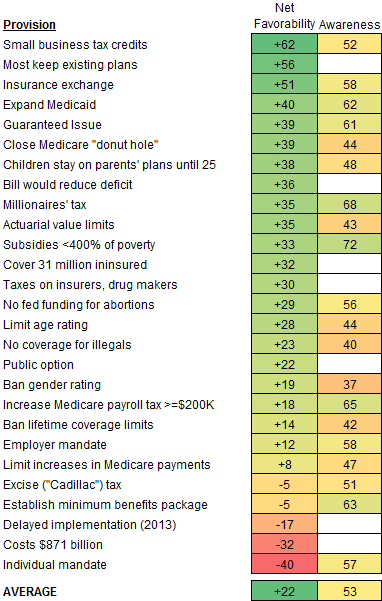
From Andrew's summary of Nate's analysis showing that most of the individual parts of health insurance reform are very popular:

Quote

What we see is that most individual components of the bill are popular -- in some cases, quite popular. But awareness lags behind. Only 61 percent are aware that the bill bans denials of coverage for pre-existing conditions. Only 42 percent know that it bans lifetime coverage limits. Only 58 percent are aware that it set up insurance exchanges. Just 44 percent know that it closes the Medicare donut hole -- and so on and so forth.

Posted Image

Quote

How would public opinion change if people were fully informed about the content of the bills? It's hard to say for sure, but on average, the individual components of the bill are favored by a net of +22 points. An NBC poll in August also found that support went from a -6 net to a +10 when people were actually provided with a description of the bill.

Obviously, it's not as though this is going to do much to help the bill's popularity in the immediate term. But in the long term, once people actually see the go bill into effect, their perceptions are liable to improve, in ways that might help the Democratic party. Although there are a few things like the individual mandate which the public obviously does not like, most of the other components of the bill are things they are liable to be quite pleased with and to find quite reasonable.

If you lose all hope, you can always find it again -- Richard Ford in The Sportswriter
0

#79 User is offline   PassedOut 

  • PipPipPipPipPipPipPip
  • Group: Advanced Members
  • Posts: 3,696
  • Joined: 2006-February-21
  • Location:Upper Michigan
  • Interests:Music, films, computer programming, politics, bridge

Posted 2010-January-26, 09:34

When it takes a year to craft major legislation, the proponents are always going to be at a huge disadvantage compared with the detractors. That's because you can't put a big sell on anything that might not turn out to be in the final bill.

The detractors are at no such disadvantage, being able to cherry pick this or that item from one draft or another to characterize negatively. Debating health care reform, opponents have done that often and have made things up of whole cloth, such as "death panels." And the democrats shot themselves in the foot with the Nebraska deal.

But the democrats will truly have cut their own throats if they don't get health care reform passed. Enough people do know that health care reform is vitally important and are really steamed at the ineptness of congress to get this done. The democrats are never going to get the votes of the anti-reform screamers. But if health care reform fails, they are going to lose the support of responsible voters as well.
The growth of wisdom may be gauged exactly by the diminution of ill temper. — Friedrich Nietzsche
The infliction of cruelty with a good conscience is a delight to moralists — that is why they invented hell. — Bertrand Russell
0

#80 User is online   blackshoe 

  • PipPipPipPipPipPipPipPipPipPipPip
  • Group: Advanced Members
  • Posts: 18,067
  • Joined: 2006-April-17
  • Gender:Male
  • Location:Rochester, NY

Posted 2010-January-26, 10:09

PassedOut, on Jan 26 2010, 10:34 AM, said:

But the democrats will truly have cut their own throats if they don't get health care reform passed. Enough people do know that health care reform is vitally important and are really steamed at the ineptness of congress to get this done.

LOL at the premise that whenever there's a problem, government should fix it.
--------------------
As for tv, screw it. You aren't missing anything. -- Ken Berg
Our ultimate goal on defense is to know by trick two or three everyone's hand at the table. -- Mike777
I have come to realise it is futile to expect or hope a regular club game will be run in accordance with the laws. -- Jillybean
0

  • 7 Pages +
  • « First
  • 2
  • 3
  • 4
  • 5
  • 6
  • Last »
  • You cannot start a new topic
  • You cannot reply to this topic

6 User(s) are reading this topic
0 members, 6 guests, 0 anonymous users